This week at the Royal College of Physicians of Ireland (RCPI), we welcomed 621 doctors newly appointed to Basic Specialist Training (BST) and Higher Specialist Training (HST) programmes. Induction week, run across five days at No. 6 Kildare Street, is an opportunity for new trainees to come together, connect with each other, and meet with their trainers, National Specialty Directors, and the RCPI leadership and staff who will support them throughout their journey.
RCPI and its six faculties and institutes are accredited by the Medical Council of Ireland as the national training body for internal medicine, occupational medicine, pathology, paediatrics and public health medicine. BST is completed in Senior House Officer (SHO) posts and HST in Specialist Registrar (SpR) posts in hospitals across Ireland.
The application process for postgraduate medical training is highly competitive. The standard of applications remains high, and demand continues to outpace the number of training places available. The number of doctors appointed to BST and HST programmes is carefully planned each year to support Ireland’s future healthcare needs. In 2026, the combined total intake was 621 trainees, compared with 596 in 2025 and 601 in 2024.
Training places, defined in partnership with the HSE National Doctors Training and Planning (NDTP), are informed by training capacity, projected workforce requirements and the anticipated future requirements for consultant posts across specialties. RCPI continues to work closely with NDTP to align programme capacity with national workforce planning priorities, secure funding for new training posts, support geographical rotations, and develop initiatives such as protected training time, less-than-full-time training pathways and simulation-based education.
Dr Diarmuid O'Shea, President of the Royal College of Physicians of Ireland said: "RCPI works collaboratively with all stakeholders, including the Department of Health and HSE NDTP, on workforce planning, the training of doctors, and supporting doctors over the course of their careers. This is the foundation for sustained progress and improvements in the health system to deliver better patient care and outcomes and support the health of the nation".
A data analysis of the past three years highlights some evolving trends.
Basic Specialist Training
RCPI offers Basic Specialist Training programmes in four specialties; General Internal Medicine, General Paediatrics, Histopathology, and Obstetrics and Gynaecology.
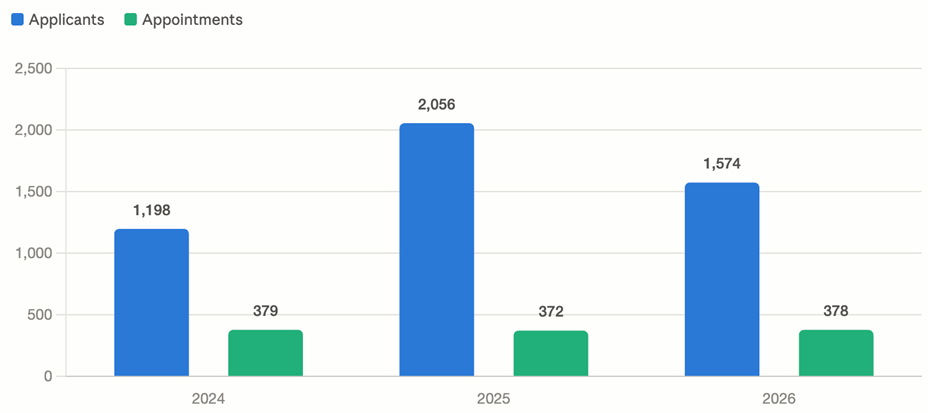
In 2026, 1,574 doctors applied for BST programmes in histopathology, obstetrics and gynaecology, paediatrics and general internal medicine. Of those, 378 were appointed to training posts. In 2025, there were 2,056 applicants and 372 appointments and in 2024, 1,198 applicants and 379 appointments. There was a spike in application numbers in 2025, with a combined increase of 858 applications across all BST training programmes.
BST applications and appointment 2024 - 2026
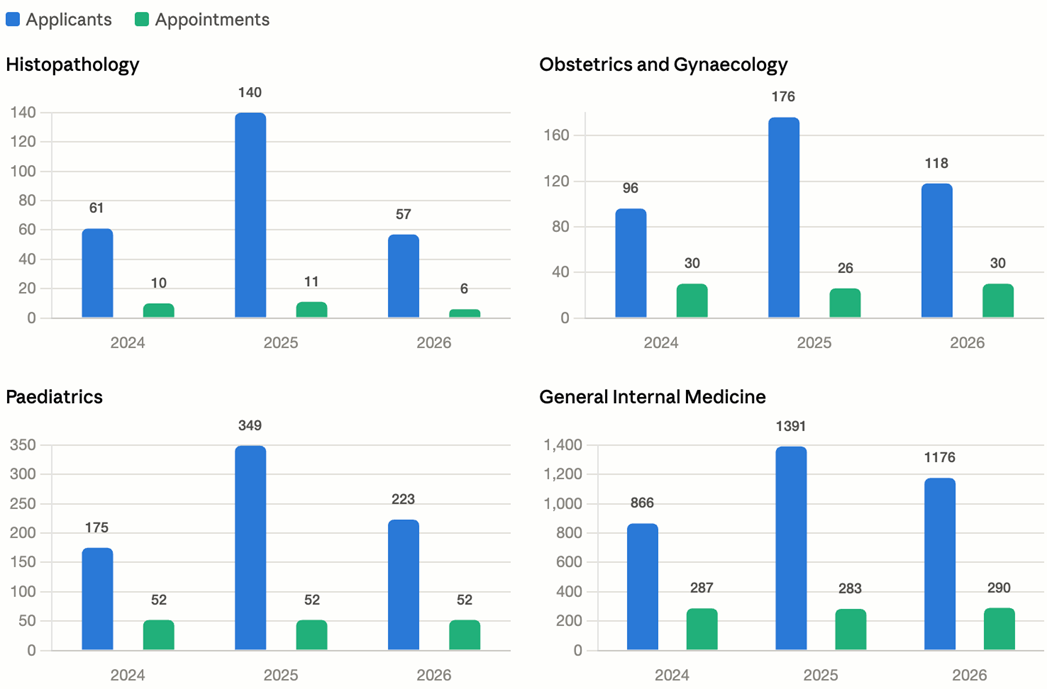
BST GIM is the largest BST programme and consistently attracts the highest number of applications. In 2026, RCPI received 1,574 applicants and appointed 290 doctors to BST GIM. Training places across all specialties remain relatively consistent across all three years. In 2026, 6 applicants were appointed to BST Histopathology, 30 to BST Obstetrics and Gynaecology, and 52 to BST Paediatrics.
2026 BST applications and appointments by specialty
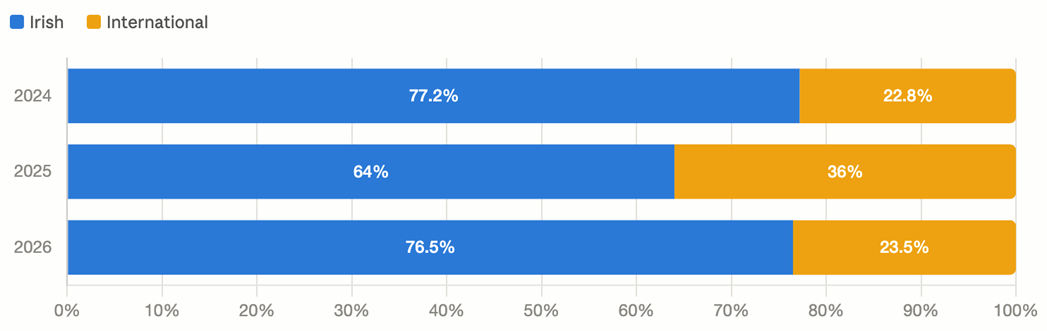
Doctors with Irish Citizenship account for 76.5% of trainees appointed to BST in 2026, compared with 64% in 2025 and 77.2% in 2024. The remaining 23.5% of trainees appointed to BST were from 37 different countries. The greatest number of doctors with international citizenship are from the UK (10), Pakistan (41), Sudan (15), Malaysia (5), Canada (5), and the United States. The vast majority of international doctors are enrolled on BST General Internal Medicine.
BST intake by Citizenship
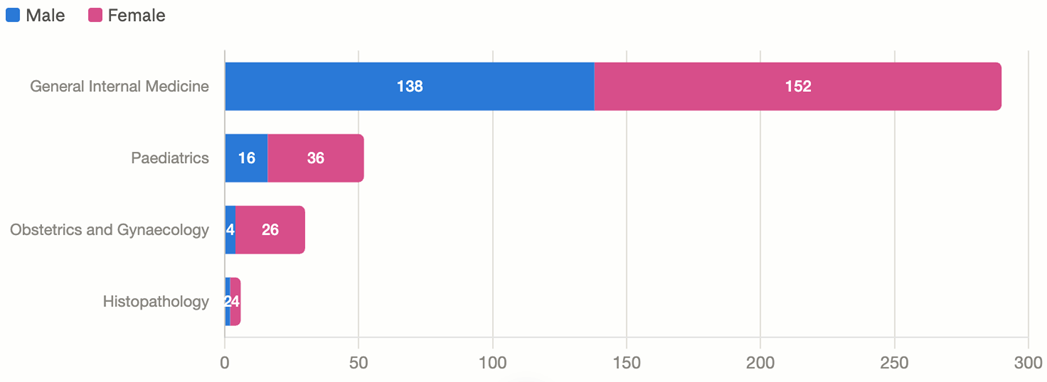
We continue to see BST female trainee numbers outpace their male counterparts. In 2026, the BST Histopathology intake consisted of 2 males and 4 females, BST Obstetrics and Gynaecology intake consisted of 4 males and 26 females. BST Paediatrics consisted of 16 males and 36 females, and BST GIM intake saw 138 males and 152 females appointed to the programme.
BST 2026 intake by gender
Higher Specialist Training
The Royal College of Physicians of Ireland offers Higher Specialist Training programmes in 29 specialties through our faculties and institutes.
Intake into our HST programmes is increasing. 243 doctors were appointed in 2026 compared with 235 in 2025 and 220 in 2024.
Some specialties saw small spikes in interest, such as HST Medical Oncology, growing from 7 applicants in 2024 to 29 applicants in 2026, and HST Haematology increasing from 15 applicants in 2024 to 24 applicants in 2026.
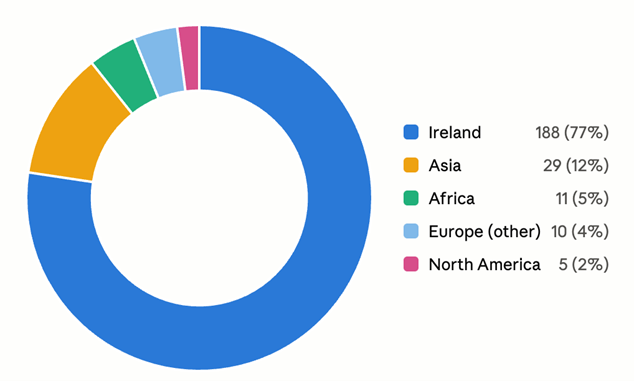
Doctors with Irish Citizenship account for 77.4% of doctors appointed to HST training programmes in 2026. This compares with 76.2% in 2025 and 83.2% in 2024. The graph below provides a breakdown of appointed trainees by country of citizenship.
2026 HST Intake by region
Across all HST programmes, female representation continues to outpace that of their male counterparts. Females on HST year 1 in 2024 represented 56% of the cohort, irrespective of specialty, compared to 63% of the intake in 2026. Some specialties remain male-dominated, most notably HST Cardiology and General Internal Medicine, HST Histopathology, and HST Haematology.
The Royal College of Physicians of Ireland wishes all our new trainees well on this next challenge in their careers. We are here to support and guide all our trainees, members and fellows over the next few weeks as you navigate changeover, new environments and new teams.