The Institute of Medicine’s annual November Symposium took place on Thursday, 27 November at No. 6 Kildare Street, drawing a large audience both onsite and online. This year’s event, featuring the prestigious Stearne Lecture and Bryan Alton Medal Lecture, brought two internationally renowned clinician-scientists to the RCPI podium.
Opening the symposium, Professor Edward McKone, Dean of the Institute of Medicine, welcomed attendees and emphasised the importance of these annual lectures in honouring leaders whose work has shaped modern medicine. “These lectures are about more than scientific discovery; they honour those who have transformed clinical practice and set new standards for patient care,” he remarked.
This year’s Stearne Lecture was delivered by Professor John V. Fahy, an international leader in respiratory medicine, who spoke on “Sub-phenotyping asthma and COPD for targeted therapies.” The Stearne Lecture commemorates John Stearne (1624–69), founder and first President of the Royal College of Physicians of Ireland, and recognises physicians whose research has had a direct impact on patient care.
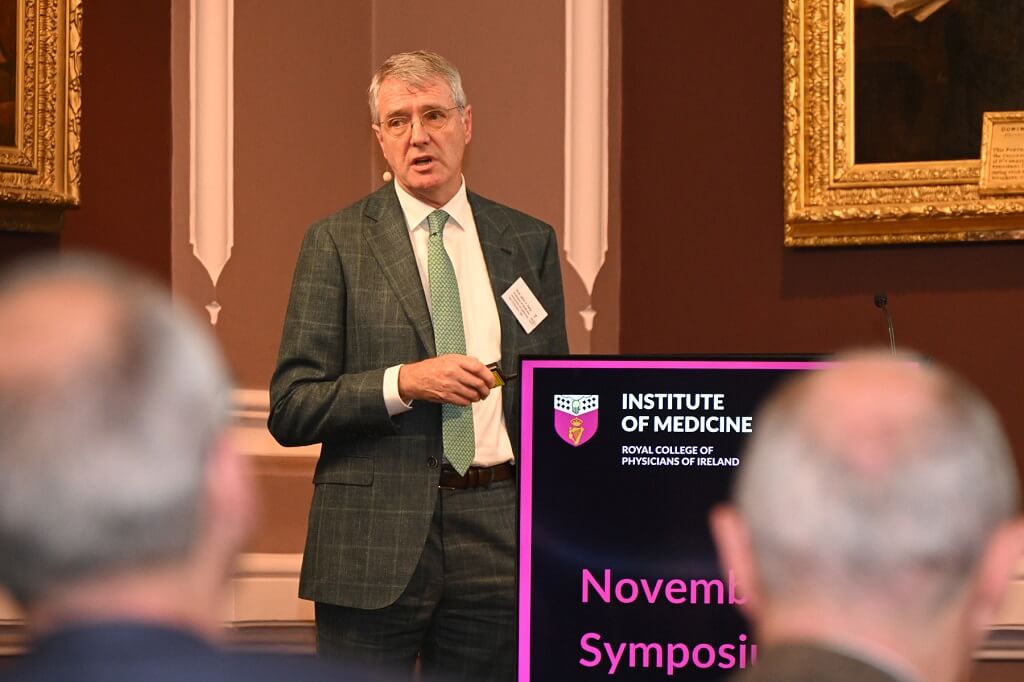
Prof. Fahy explained that sub-phenotyping allows clinicians to identify meaningful differences between patients: “A patient’s phenotype describes the particular type of disease they have in terms of severity, allergic inflammation, imaging features and treatment responses. Sub-phenotyping is important because research to identify the molecular mechanisms underlying these differences can lead to targeted treatments. This is precision medicine and it replaces a one-size-fits-all approach that fails many patients.”
Prof. Fahy also explored airway mucus pathology in patients with COPD and asthma, an area of growing clinical importance. Recent CT-based studies show that many patients are “mucus plug-high” a phenotype associated with more severe disease and poorer lung function. “These findings raise the possibility that treating mucus plugs by making mucus plug-high patients mucus plug-low will improve lung health,” he noted.
Prof. Fahy also spoke about his own career path, reflecting on how clinical practice shaped his transition into a physician-scientist.
The Bryan Alton Medal for 2025 was awarded to Professor Orla Hardiman for her exceptional contribution to clinical neurology and translational research in Amyotrophic Lateral Sclerosis (ALS). The award honours the legacy of Bryan Alton, RCPI President from 1974 to 1977, who championed medical education and training in Ireland.
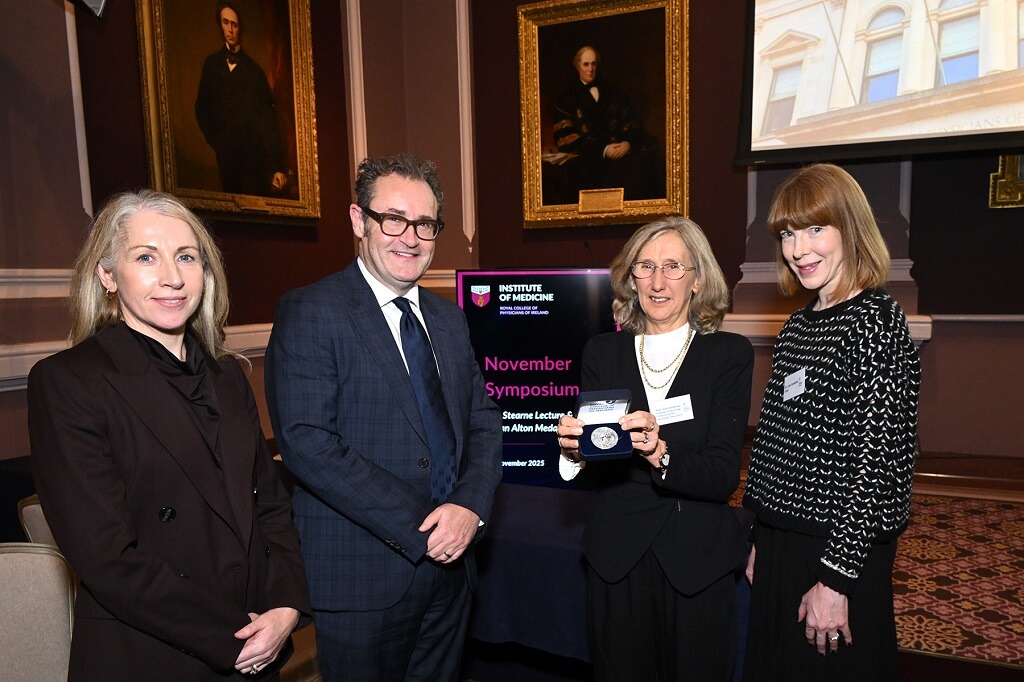
Prof. Hardiman’s lecture, “Deconstructing Amyotrophic Lateral Sclerosis: From Bedside to Bench and Back Again,” examined why ALS remains so difficult to treat and how emerging technologies are helping to unravel its complexity.
She highlighted the profound heterogeneity of ALS, noting that while it is classically defined by motor neuron degeneration, many patients also experience cognitive and behavioural impairment. “Understanding the basis of heterogeneity is crucial to the success of future drug development,” she explained.
Prof. Hardiman shared insights from her research philosophy, emphasising that the bedside must inform the bench and not the other way around. “By focusing on patient attributes at the bedside as the starting point, our objective is to provide a scientifically robust pathway back from the bench to guide future therapeutics,” she said.
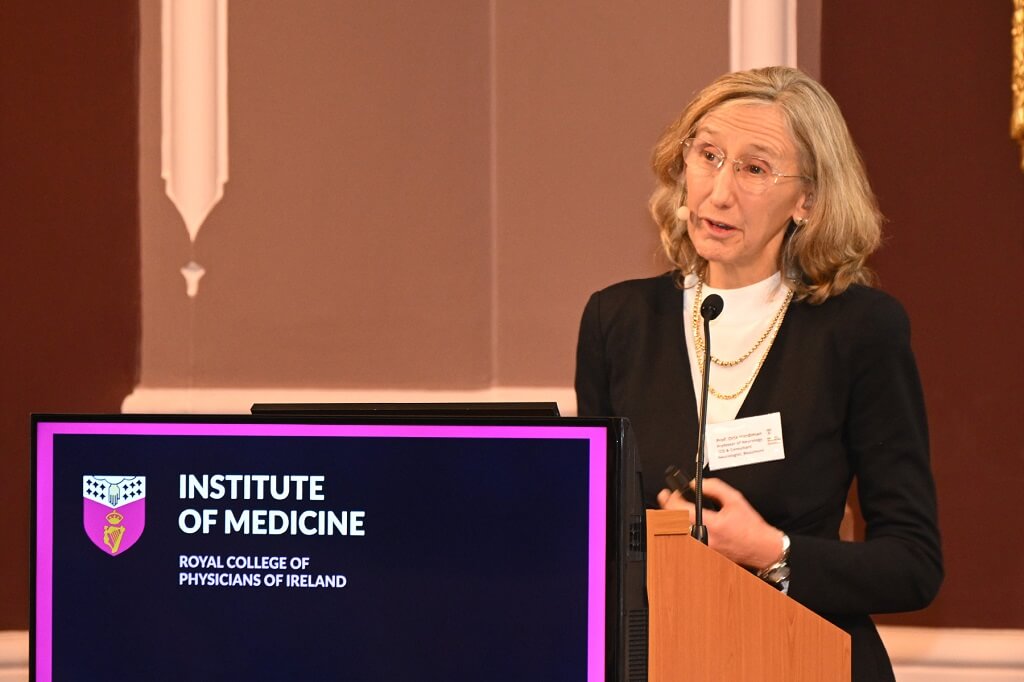
Looking ahead, she described how the Precision ALS programme, an Ireland-led project supported by Research Ireland, ADAPT and FutureNeuro, will combine clinical data, biomarker results, genomic information and device-based measures in one large system.
“To make real progress, we need large-scale human datasets and improved analytic tools. Unless we embrace this approach, we risk repeating past errors, and the likelihood of developing truly effective disease-modifying therapies will be greatly reduced,” she argued.
Closing the evening, Professor McKone thanked both speakers for their outstanding contributions to what he described as “a stimulating and inspiring programme that highlights the very best of clinical and translational research.”
Image gallery